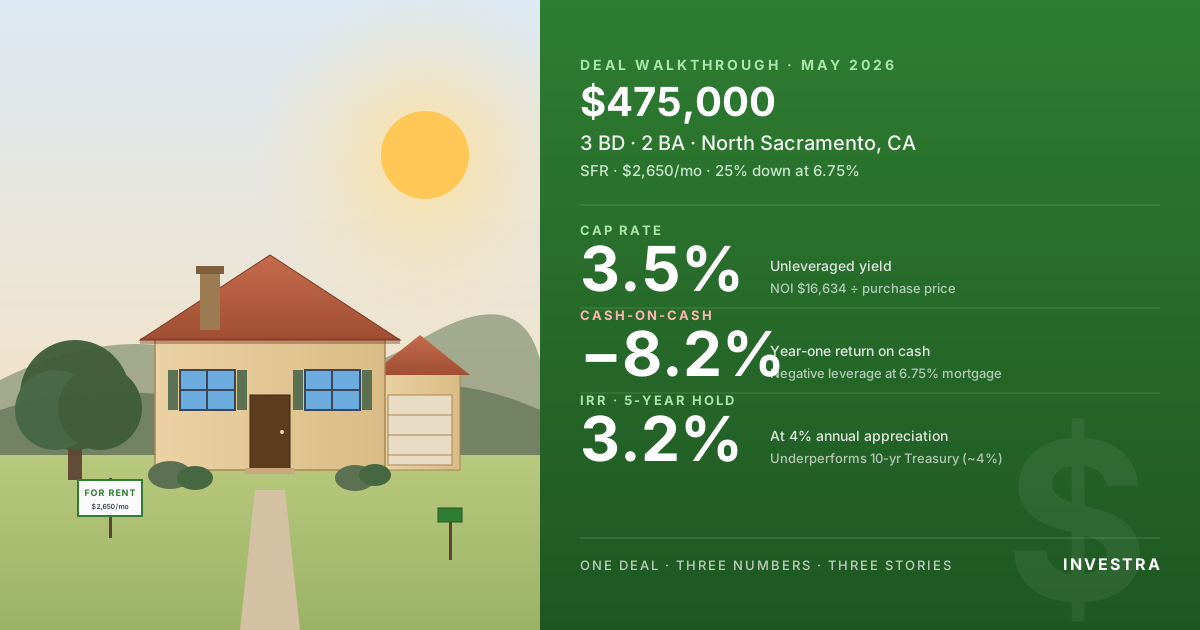
Most rental analyses stop at "the cap rate is X." That's the analysis that loses investors money. Here is a real California deal in 2026, walked through cap rate, cash-on-cash, and IRR — and the very different stories each one tells.
The 30-second answer
You need three numbers, not one. Cap rate measures the property's unleveraged yield. Cash-on-cash measures what your money earns in year one. IRR measures what your money earns over the full hold, once you include appreciation and mortgage paydown. A deal that looks bad on cash-on-cash can still produce a respectable IRR. A deal with a strong cap rate can still lose money once you add a mortgage. You need all three.
The property: a $475K Sacramento rental
Our example is a 3-bedroom, 2-bath single-family home in north Sacramento, listed at $475,000, with comparable rentals leasing for $2,650 a month. The kind of deal a realtor would actually bring an investor client in May 2026.
| Input | Value |
|---|---|
| Purchase price | $475,000 |
| Down payment (25%) | $118,750 |
| Closing + initial improvements | $17,000 |
| Total cash invested | $135,750 |
| Mortgage (30-yr fixed, 6.75%) | $356,250 → $2,310/mo P&I |
| Gross monthly rent | $2,650 |
| Property tax (Sacramento Co. effective) | 1.10% / yr |
| Insurance | $1,800 / yr |
| Vacancy / mgmt / maintenance / CapEx | 5% / 8% / 8% / 5% of rent |
How do you calculate cap rate?
Cap rate is the property's unleveraged yield — what it would earn if you paid cash.
Cap rate = Net Operating Income ÷ Purchase Price
NOI is gross annual rent minus vacancy and all operating expenses, but not the mortgage. For our deal:
| Gross annual rent ($2,650 × 12) | $31,800 |
| Less vacancy (5%) | ($1,590) |
| Less operating expenses (tax, insurance, mgmt, maintenance, CapEx) | ($13,576) |
| NOI | $16,634 |
Cap rate = $16,634 ÷ $475,000 = 3.5%. That's roughly in line with Sacramento in 2026; coastal California compresses to 2.5%-3%. It tells you the property is fairly priced. It does not tell you whether the deal works for you with your financing.
What is cash-on-cash, and why does it differ?
Cash-on-cash brings in financing and your actual cash invested.
Cash-on-cash = (NOI − Annual Debt Service) ÷ Cash Invested
| NOI | $16,634 |
| Less annual debt service ($2,310 × 12) | ($27,720) |
| Pre-tax cash flow, year 1 | ($11,086) |
| Cash invested | $135,750 |
| Cash-on-cash | −8.2% |
This is where most first-time investors flinch. The diagnosis: the mortgage rate (6.75%) is higher than the cap rate (3.5%), so the property has negative leverage — every borrowed dollar costs more to service than it earns. That is the reality of most California residential rentals in 2026. It does not kill the deal automatically, but the case can't rest on year-one cash flow. It has to rest on IRR.
What does IRR tell you that the other two miss?
IRR is the annualized return across the full hold, including each year's cash flow, mortgage paydown, and the sale price at exit. It's the only metric that captures the time value of money.
Assume a 5-year hold, 3% annual rent growth, 2% expense growth, and 4% appreciation (a conservative inland-California estimate). Operating losses shrink each year as rent grows ahead of expenses. At year five, the property sells for ~$578K. After paying off the remaining ~$334K mortgage and 7% selling costs, the investor walks away with about $203K in net proceeds.
Plug all six years of cash flows into an IRR solver:
IRR ≈ 3.2%.
A property that looked like a 3.5% yield and an 8% annual loss actually delivers a 3.2% annualized return — almost entirely from appreciation. With 10-year Treasuries near 4% in May 2026, this deal underperforms risk-free. Bump appreciation to 5% and IRR climbs to ~5.5%. At 6%, above 7%. The deal lives or dies on the appreciation assumption — and cap rate and cash-on-cash never told you that.
How the three numbers fit together
| Metric | Answers | Misses |
|---|---|---|
| Cap rate | Is the property fairly priced for its operating income? | Your financing and appreciation |
| Cash-on-cash | How does my cash perform in year one with the mortgage? | Future rent growth and appreciation |
| IRR | What annualized return do I earn across the full hold? | Sensitivity to the appreciation assumption |
The pattern: cap rate first to screen pricing. Cash-on-cash next to test whether you can hold it without bleeding more than your investor will fund. IRR last to confirm the total story — then stress-test it at 1%-2% appreciation. For deeper definitions, see our top five real estate investment metrics post.
Why a spreadsheet (or ChatGPT) won't cut it
Twenty minutes of math for one property is fine. Twenty properties with three appreciation scenarios each is unmanageable. And pasting client financials into ChatGPT is worse: language models don't have live rent comps, current tax rates, or today's mortgage pricing — we wrote about why general-purpose AI is the wrong tool for real estate underwriting. With inventory up in the spring 2026 buyer's market, investors finally have negotiating leverage — but only if their realtor can model deals fast enough to use it.
Investra runs every calculation in this article in seconds, pulls live tax and rent comps, and produces a branded report you can hand to your investor client.
Frequently asked questions
What is a good cap rate for a California rental in 2026?
Most California residential rentals trade at 3%-5%. Coastal metros compress to 2.5%-3.5%. Inland markets like Sacramento, Fresno, and Bakersfield run 3.5%-5%. Anything below 4% is typically an appreciation play, not a cash flow play.
Why is cash-on-cash negative when the cap rate is positive?
When the mortgage rate exceeds the cap rate, the property has negative leverage: debt service costs more than operations earn. Cash-on-cash turns negative even with a positive cap rate. This is common in California in 2026.
What's the difference between cap rate and IRR?
Cap rate is a single-year snapshot of operating yield, ignoring financing and appreciation. IRR is the annualized return across the full hold — cash flow, principal paydown, and exit price all included.
Can a property with negative cash flow still be a good investment?
Sometimes. Deals can pencil with negative year-one cash flow but positive IRR over a five- to ten-year hold once appreciation and principal paydown are included. The risk is funding the shortfall monthly and depending on appreciation actually materializing.
What appreciation rate should I assume for California rentals?
Long-term California appreciation averages 4%-5%. Conservative 2026 underwriting uses 3%-4% inland and 4%-5% coastal. Always model a 1%-2% downside to test how durable the return is.
The takeaway
One number is never enough. Cap rate, cash-on-cash, and IRR each illuminate a different dimension of the same deal. Run all three on every property. Stress-test the IRR. Then decide.
Ready to run these in seconds? 👉 Get Started with Investra